Tuesday, 3 July 2012

White Dog (1982) Samuel Fuller


One night driving home Julie knocks over a dog, a white German Shepherd. She takes it to the vet and then home. Over the coming weeks Julie learns that not only has the dog been trained to attack people but to attack black people, any time and any where, without discrimination.

Black men were paid to hit it, you see, and hurt it until no reason to hate became every reason.

The dog does not represent racist people (they represent themselves) but racism in pure form passed on and cultivated by individuals. That which was invisible behind the trainer's benign smile and gently proffered rattling tin of sweets reveals its terror in blood-stained fur and borne fangs.

It is emotion and rage unfiltered by common decency or social constraints. 


If one were to take White Dog, both film and protagonist, as a comprehensive allegory/metaphor then it would prove incomplete and inadequate. White Dog is a picture about the evil of and seemingly intractable struggle against racism and in that regard it concentrates on nurture, the influence that others can have on us and, though not explicitly, how difficult it is to diverge from those paths we have started down.

Teaching, brainwashing, indoctrination, whatever name it wears. 

The absence here of a dramatised 'discussion' of innate racism (nature) suggests that it is either being rejected out of hand (a hopeful thought implying that there is a cycle that can be broken), something that positive nurture can unpick, or merely too thorny an issue to broach.

White Dog emerges relatively unscathed from the minefield of traps that come with territory of this kind : manipulation, sensationalism, one-eyedness, or the potential for a (hypocritical) black people v white people dynamic.

Although the film is of course (apart from being fiction, albeit fiction that reaches out and touches real nerves) about white people's attitudes to black people abstracted through a dog, no additional race-based conflict is intentionally set up by the film. Images such as the one above may have been problematic and/or provocative (leaving aside that provocation is a tango for two willing partners) if the sometime fevered emotional pitch of the film had come to cloud its cool, measured and fundamentally good disposition.

*                        *                         *

Julie takes the dog to an animal training centre and is told that the dog must be put down. An attack dog we are led to believe can not be saved. One man at Noah's Ark, though, a maverick trainer called Keys, a black man, takes on the task on Julie's behalf. His belief that a racist dog can be untaught has come to obsess him, a mix of professional pride, personal suffering, passion and compassion. He has failed with other dogs. He wants to tear out that racist hate once and for all, and alter man's vicious ways through the dog's salvation, from effect back up to cause.

White Dog, its gnashing despair, its espoir éclaté, its gritted tension of sharp teeth and soft meat has the power of a raging current so powerful that only rarely can the declamatory and essayistic underpinnings, the laudably apparent conviction poured into the work, come bobbing gauchely to the surface of the narrative:

"That dog is sick!"

"Then he should be cured!"

"Darling, the people that made him sick made him permanently sick!"

"Then they should be put to sleep, not the dog!"


This argument between Julie and her boyfriend is, thankfully, an exception, though its stridency can be forgiven in part by Julie's earlier visit to the dog pound and its awful death chamber.

Regardless, it is not enough to have ideas but to give them life. Here is life. Here is life that we can care about, the girl's pains, the trainer's sorrow, the dog's hair-trigger psychosis. In the end it feels as if the dog's fate is mankind's - can it resist hate in the loving embrace of its owner? At Noah's Ark, in an earth-like cage complete with lines of longitude and latitude, can we be saved, will all the sin be washed away in the great flood?

Here is a microcosm:

Microcosm : Fighting for Earth

After all his training, Keys gives the dog a final test. Black skin exposed, dog unchained, the battle against racism is won. Julie hugs her panting, smiling dog. The camera begins to circle them triumphantly, spinning across Julie's face, around the back of her head, until we return to the dog, no longer Jekyll but Hyde (as the trainers learn to call him), a snarling red-eyed beast. The battle against hate is lost, against the pain of abuse. Julie's loving embrace lets slip the dog of war and he runs at the Ark's white owner, a picture of the man who first infected him with loathing.

The sight of the dog in full flight, accompanied by Ennio Morricone's plaintive, terrifying music, is nothing less than tragic. The man is mauled.

The dog is shot and lies in the sand, its face still contorted in a rending grimace. No solutions, no easy fix, no end in sight. All that is left is the mask, the mask that has become the face.


Violence deafens us to violence and its acts. Earlier, in Julie's clifftop flat, the dog could not hear an intruder attempt to rape her because of explosions detonating on the television.


Nurture can be that which we absorb unconsciously at a time when we have no choice in acquiescing or that which appeals to us instinctively and we take on as our own with some manner of agency.

Keys tells us that he didn't want to work in Anthropology, as his parents do, yet his life's work is remarkably similar - dusting for human fingerprints left on fur. We see, when Julie pays a visit to a black friend attacked by the dog, that she is clutching Francois Truffaut's book on Alfred Hitchcock (click on below image for a closer look). Truffaut had long professed his admiration of Hitchcock's work and acknowledged its impact on his own style.


These influences, these impacts, these marks : can they be ironed out like freshly raked sand, or do the wounds remain forever, to be salved but never to be healed.Try or give up, redeem or wipe out? Who is on the Ark and who is off?

*                          *                             *

As I said before, White Dog should not be taken as a comprehensive manifesto on racism but a purposely narrow and squeezed cry of anguish, an appeal and yes, a rollicking story.

I have written out (or will be about to write out) below some letters written in response to LIFE magazine's review of the book by Romain Gary on which Fuller's film was based. They provide a glimpse of  real-life wrestles and a flavour of the complex and troublesome knot at the heart of racism and its depiction:


...Gary doggedly keeps trying to induce guilt...it's a phony, LIFE, and like so much of the racist garbage printed these days, it's completely negative, with neither constructive thought nor inspiration
                                                                      Colin G Male

Most of your readers will be surprised and shocked to read about the cruel misuse and tortured training of attack and guard dogs. The sad fact is that we and many animal shelters see daily evidence of White Dog and Black Dog - poor abused creatures ruined by man and so demented with fear and nervousness that our greatest service to them is prompt euthanasia

                                                                       Mrs Paul Kiernan, President,           Washington Animal Rescue League

Some months ago I translated from Polish Echoes of Treblinka, a short story of Stefan Korbonski, a wartime underground leader in German occupied Poland. This story tells of a dog trained to kill inmates of a Nazi concentration camp. The dog, pride and joy of his master, SS Haupststurmfuehrer Hans Bauer, is retrained by a Jewish veterinarian (a camp inmate) during Bauer's absence and kills his master on his return. 

We are capable of producing White Dogs in any circumstances. Whether it's "Alle Juden Raus!" or "Get them niggers!", the obscenity is the same

                                                                       Marta Erdman


Julie approaches the dog pound's death chamber


Saturday, 16 June 2012

The Greatest Films Bandwagon Jump


Over a year ago I counted down my fifty greatest films of all time. My selection criteria paid no heed to critical canons or accolades, technological breakthroughs, historical influence or any opinion held or impact felt beyond my own experience with the flickering white skin called cinema.

This year Sight and Sound again asked prestigious directors and critics for their top tens. It is very hard to jump on a bandwagon that has reached top speed which is just as well; why choke on somebody else's dust-cloud, anyway, when you kick up your own.

So here is an updated list, this time in chronological order, of my greatest films ever made. I really don't know what use it has beyond, maybe, introducing people to films they don't know or encouraging them to re-watch something that may work a second time.

With apologies to the 1930s...


1922 Cinderella (Lotte Reiniger)
1927 Sunrise
1928 Lonesome
1940 Rebecca
1943 Day of Wrath
1945 Roma Citta Aperta
1946 The Postman Always Rings Twice
1953 Gion Bayashi
1955 Pather Panchali
1956 The Searchers
1957 Forty Guns
1959 World of Apu
1960 Innocent Sorcerers

1962 The Trial of Joan of Arc
1962 L'Eclisse
1963 The Birds
1964 Woman in the Dunes
1966 Au Hasard Balthazar
1967 Playtime
1970 Ucho
1970 This Transient Life

1971 King Lear (Kozintsev)
1971 Szerelem
1972 Hotel Monterey
1973 The Exorcist
1975 Mirror
1977-2005 Star Wars
1981 Le Pont du Nord
1982 Fanny and Alexander
1982 White Dog
1982 Poltergeist
1984 Once upon a time in America
1985 Ran
1986 Labyrinth
1986 Aliens
1988 My Neighbour Totoro
1988 The Vanishing
1988 Die Hard
1988 The Naked Gun
1989-90 Dekalog
1992 Twin Peaks : Fire Walk With Me
1993 Abraham Valley
1993 Patlabor 2 The Movie
1994 Chungking Express
1994 Satantango
1994 Crows (Dorota Kedzierzawska)
1994 Jeanne la Pucelle
1995 Whisper of the Heart
1996 Freeway
1996 Drifting Clouds (Kaurismaki)
1998 Dark City
1999 Rosetta
1999 All About My Mother
2000 Crouching Tiger, Hidden Dragon
2001 A.I.
2001 Mulholland Drive
2001 Pulse (Kiyoshi Kurosawa)
2002 Demonlover
2002 Dark Water (Hideo Nakata)
2002 Liberte et Patrie (Jean-Luc Godard - short)
2004 The Village
2005 Three Times
2005 The Wayward Cloud
2005 Oxhide
2005 The New World
2006 Southland Tales
2006 Offside (Jafar Panahi)
2007 Lust, Caution
2007 The Romance of Astrea and Celadon
2007 The Flight of the Red Balloon
2007 The Bourne Ultimatum
2008 Love Exposure
2008 Shirin
2009 Antichrist
2010 Film Socialisme
2011 Melancholia
2011 Sucker Punch


Monday, 28 May 2012

Unearthing Grief and Love in Super 8


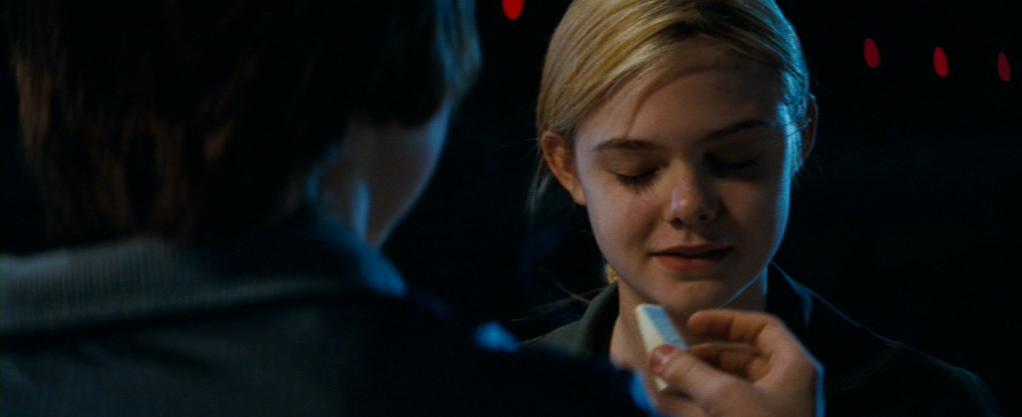
The word 'superate' means to rise above, to surpass, to overcome, to surmount and to get over. Super 8 is a love story and a monster movie but fundamentally it is about a boy coming to terms with the death of his mother.

A hole has opened up in Joe's and his father's life and they are battling not to be sucked into it. Their fight against grief, which they keep hidden as deep down as where they are wounded, comes to the surface through the metaphor of war.

Joe is working on a film with friends. In one scene we see him playing a soldier. Later his Dad disguises himself in army uniform so that he can find out what they know about the alien rampaging across their town. The carnage caused by their unwelcome visitor - buildings trashed, cars overturned, tanks misfiring - is an image of an all-consuming grief so large that it begets a war zone.

Fighting - The Internal made External

At the end of the film, when Joe begins to come to terms with his mother's passing, the alien leaves (alien emotional presences for a young boy - grief, love etc. - form the backbone of the film) and takes the soldiers' guns with it. Both battles were joined and dissolved as one.


This battle that Joe is fighting within himself stands in the way of, and is eventually won with the help of, his friendship with Alice. This is beautifully visualised with the same war metaphor when, to let her climb into his bedroom, he has to remove a row of toy soldiers from his windowsill (and literally let his guard down).


Alice brings him both pleasure and pain. There is ample reason to believe that she reminds him of his mother, whether through her kindness, her aura, or simply by virtue of the emotions she stirs up within him. It is telling that when his father forbids him to see her Joe describes her character as motherly: "she's kind...she's nice to me".

In his mind, symbolised by her role as a zombie in their film, she represents life and death, a reanimation of interred suffering and love.

(Above) Zombie Alice 

Death and Life

(Below) "Relive the Memories" - Talking to Alice on the phone

Being around her is awkward and not merely because he is unschooled in managing romantic sensations. Their burgeoning intimacy steals in to where he is sore. She makes him happy and sad all at once, guilty perhaps, vulnerable certainly.

Joe tells Alice how when his mother "really looked" at him "he knew that [he] was there...that [he] existed". When Joe is applying her makeup (with which brings out life and death) for the purpose of the film Alice mentions the accident that killed his mother. Joe asks her to close her eyes and tears begin to well up in his. He cannot stand her to "really look" at him in the same way and see inside. Love falls into grief and here Alice comes to stir it before it is ready to be awaken.


Alice, in the absence of his father's (a bereaved man busy dealing with the aftermath of the extraterrestrial breakout) comfort, protects Joe and heals him. We see this most clearly via the surrogate of Joe's model train.

Cradling Joe

Train carriages come to stand for Joe himself. For the purpose of the film, Charles wants to blow up one of the model trains Joe has made and painstakingly decorated. Joe agrees but Alice encourages him to stand up to Charles. Alice, by intervening, is guarding Joe's heart and encouraging him to see that things can still have meaning.

He shows her one of his lovingly painted carriages - thanks to her he still values himself enough to share his soul, shyly proudly, with her.

The alien is released by a train crash that occurs at a moment of emotional crisis. Joe is watching Alice film a scene in which she declares her love for her character-husband. Joe places herself in his shoes, bewitched by this wonderful girl, and the ungainly euphoria hits him, literally, like a train. In a sense, then, Alice creates upheaval and kick-starts the slow assimilation and dissolution of undigested grief. The alien emerges from the wreckage.

As Joe watches, the creature bursts open an upturned carriage as if it is breaking out of him. The alien is grief, it is chaos, it is a catalyst, magnet and vector for sorrow. 

The alien breaks free from the train

The alien is a restless ghost. It is hurt and angry, held hostage by the army and prevented from going home. She too is kept from going 'home' by the knowledge that Joe is not OK. It is a corpse that builds a subterranean realm beneath the cemetery where Joe's mother lays. Buried bodies, buried feelings.

(Above) The image of the alien projected on Joe's face

The alien is Joe. In the denouement Joe looks into the alien's eyes, "really looks", and tells it "bad things happen but you can still live". Joe stands outside of himself and reassures his trembling heart. The alien's cold horrific eyes part to reveal its eyes of no little warmth and light beneath. They have helped each other see.


It leaves. It takes parts of the town with which to create its spaceship; Joe's mother took a part of him with her. The last piece of the "model" the alien crafts (it is a model-maker just like Joe) is a locket Joe carries with him. Inside is a picture of him and his Mum when he was a baby. Joe hangs on to it as it is pulled upwards...and then he lets go.


Letting Go


The alien has let go, Joe has let go, and his mother has been allowed to go. Though he will never forget and the ache will never relent, a weight is lifted, the crushing bulk of grief.

Joe and Alice look up into the night sky, into heaven, and smile as it departs. Their fingers intertwine. Joe holds her hand softly where he would once grip his mother's image fiercely, jealously, desperately. Godsends, Alice and the creature both.

This wasn't just an alien or a monster but so much more - it was everything monstrous and everything alien.


Monday, 14 May 2012

The New Cinema of Shattered Minds


Delusions, split realities, multiple personalities; the erection and dismantling of psychosis, or something like it, is the most notable preoccupation in modern cinema.

Trapped in a room, stuck in a cave, tortured by visions, something's amiss, all is askew, zombies, monsters, killers, they're after you. Our heroes and heroines are men and women in trouble. Or everything's OK...until the wallpaper begins to peel.

The major questions in these films are 'what is happening?', 'what is real?' and even 'who am I?'. What is dream and what is reality in Inception? What is imagined in The Ward, Bug or Take Shelter? What is damaged? You, the world, or both?

The intensification of disorientation and misinterpretation of experience reach awakening and we see, finally, how much was delusion. We understand that an illusion had been constructed, Switchblade Romance, The Uninvited, that falls when the fake expands to bursting or fades to natural end. We see the lies beneath the crises, twisted adventures. We see how visions of happiness were always only that - visions.

The world was never out there but in here, in the mind. But what triggered delusion? The heart of all of these films, 1408, Triangle, is trauma. Trauma that forces a break from reality. In mental collapse pain is moved to another level and manifest in horrific metaphor. Elsewhere involuntary 'coping mechanisms' kick in where a happier narrative, Mulholland Drive, Dream House, masks and abstracts suffering, a Bougereau painted on top of a Bacon.

A dead daughter, a dead husband, a dead wife, guilt over murder, Shutter Island, Mulholland Drive, obsessive jealousy, loss and fear of loss, this trauma is a boomerang. These stories emanate from it (many of these films have a pre-delusion section in which we are obliquely 'told' what provokes it) and return to it. The tendency of the puzzle-story is that the completed jigsaw should reveal something terrible, even worse than what may have been suffered in the unreality. Yet that terrible, by its very human nature, in conjunction with the clarity of revelation, has an uplifting dolorous call - grief is love in death's grip.

Trauma has its foot in the door preventing The End's storybook closure. Because these loves live forever so must trauma. Trauma distorts reality. The truth is impossible to accept. You become new people playing different or multiple roles (where they are effectively opposing themselves) in dumbly detached and remotely twinned realities.

Stories are not going to save you (apart from in Sucker Punch, where stories are under partial conscious control) but they do, incidentally, help. Truth and understanding wait where they have led you, where they have finally failed.

Three trends of 21st Century cinema that come together in the new cinema of the broken are the puzzle narrative, the twist and unresolved ambiguity.

The puzzle narrative gained strength at the end of the last century with the success of Memento and The Usual Suspects. The revelatory twist that overturns what we have been led to believe achieved especial popularity, likewise at the end of the 1990s, on the back of The Sixth Sense and Fight Club. Ambiguity, Martha Marcy May Marlene, Lost in Translation, letting the audience write the last page, is a directorial tic still emerging.

What brought these trends together, apart from the popularity of each? I don't know. Perhaps the traumatic events in the United States of America in 2001 have obliquely and subconsciously been depicted with the freshly forceful modes of storytelling to which they are peculiarly suited. Puzzles, twists and ambiguity lend themselves to confusion, paranoia, cruelty, sadness and cold brutish reality.

There's no way out. It doesn't seem real. It's just like a film. Like a dream.


Saturday, 5 May 2012

The Shining : Analysing an Image # 2

Here Jack is smashing his way into the bathroom where Wendy cowers in fear

The wood-chopping man, the centuries-old strong and comforting figure of a husband and father is here turned against the family.

The wife and mother screams. As she brings her hand up to her face her wedding ring is visible.

From this acute angle across the door the axe seems so much bigger and the butcher (kitchen - female) knife Wendy holds so much smaller and inadequate seeming. This is a battle she appears incapable of winning.

The colours are cold, stark and anaemic. They are dirty and off-white. The tiles tell us that this is a room where things are meant to be clean and made clean. Instead there are stains: literal, be it on the walls themselves, or figurative, on the sanctity of home and the sacrament of marriage.

One briefly thinks of a more specific violation, rape, as the large axehead thrusts against and through the wood and, from this angle, 'into' her.

Her face shows abject terror. She looks as if she is weeping, overwhelmed with sadness that it has come to this.

With the axe in between us and her, she is made more helpless, separated from us. We are not able to intervene and are placed as if another victim hiding on the other side of the door.

However, the camera's focus (and ours) remains more on her than on the horrific axe, whose intrusion is more other-worldly, more difficult to comprehend by being indistinct and blurred.

Wednesday, 14 March 2012

Movie Morality Debate Topics


Here I bring the week of pieces on the morals of film to an end with a few thoughts for debate.


Playing Tricks 

What are the issues surrounding a film which pretends to be fiction and isn't or pretends to be real and is fictional or fake. Think of the ambiguous natures of Abbas Kiarostami's Shirin, of Catfish or Exit through the Gift Shop. Do we need to know whether a work of art is 'real' or 'unreal'? Is it our right? Are we being betrayed?

Do we need to be more aware of how documentary film-making skews reality in conscious and unconscious ways?

Special Editions, 3D, Directors Cuts....

The rapid advancement of technology has facilitated the creation of many variations of the same work. Does greed play a part? Is our sense that only watching all the versions would represent a proper knowledge of the work being exploited?

Altering Films

To what extent do we own or have a stake in films that we have seen? Think of E.T. and of Star Wars.


  Back from the Dead

What are the moral implications of revivifying the image of dead actors and actresses?

Censorship

What should be censored? Should we allow the worst things imaginable be screened, as long as what is filmed remains fictional/simulated? When, if ever, can the unchecked exercise of freedom be damaging?

 Piracy

Are the lines blurred, in a world of easier and easier access to media, between right and wrong? Do rights holders exert too much control?

Inspiration vs Theft

Where does homage become plagiarism?

Moral Messages for Children

Are films in general perpetuating the tyranny of groups and cliques? How are friendships, parental relationships, love stories and sexual relationships presented, coded and resolved? Are they imprinting the right things in children's minds? Are children's films coarser than they were? Do we need to be more careful in children's films where the audience may be more impressionable and the conscious filtering of fictional from real less sophisticated?

How do we navigate the need of art to reflect the real and explore the unreal, to remember the world as we forget it? Should artists be encouraged to offer enlightenment?

Most importantly, how much of an impact do films really make on us? How much (if we take modern film as one entity) of us as we are is on the screen? How much of us as we will be?

I may pick up on a couple of these questions in the future.